RESEARCH


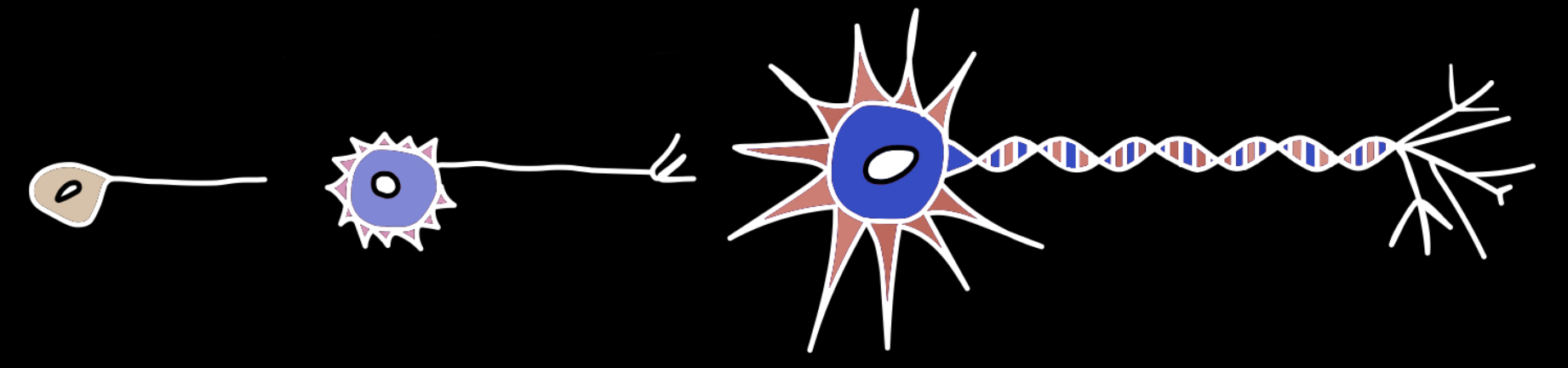
Building a nervous systems requires both the specification and maturation of diverse neuron types. Most post-mitotic neurons are specified in a brief window of time during embryonic/fetal development, but they continue to mature for weeks in mice and years in humans. For example, even though motor neurons are specified early during embryonic development, motor behaviors such as posture control, crawling, walking, and running, gradually mature over a span of years during postnatal life. During this prolonged period of maturation, neurons undergo dramatic changes in morphology, electrophysiology, gene expression, and chromatin structure as they integrate into circuits and become functionally mature.
Compared to our understanding of cell-type specification, the regulatory mechanisms that orchestrate maturation of post-mitotic neurons remain poorly understood. This discrepancy is also apparent in cell culture studies - while diverse neuron types can be efficiently differentiated from stem cells, culture systems do not recapitulate full neuronal maturation. Studying maturation is therefore crucial for understanding how adult nervous systems develop, generating mature neurons in culture, and mechanistically understanding diseases such as schizophrenia, Alzheimer’s, Parkinson’s, and Amyotrophic Lateral Sclerosis (ALS), which specifically affect maturing or mature neurons.
QUESTIONS AND PROJECTS
Our ongoing work uses spinal motor neurons as an entry point to dissect how neuronal maturation is regulated in mice, and which aspects of maturation can be recapitulated in culture. By using genomics and computational approaches, we have found that both gene expression and subtype composition within in vivo spinal motor neurons are highly dynamic as these neurons transition from embryonic to adult states (Patel et al., 2022; Chen, ... Patel, 2025). These changes coincide with assembly of motor circuits and functional maturation of motor behavior (Chen, … Patel, 2025), and are relevant for age-dependent disease pathologies in ALS (Lowry*, Patel* et al., 2025). In ongoing in vivo work, we are dissecting the developmental principles that dictate changes in motor neuron subtype identity during maturation, and manipulating these mechanisms to understand how they determine subtype vulnerability of motor neurons in ALS. In addition, we are testing whether stem cell derived motor neurons can recapitulate an in vivo adult-like state in culture.
We are broadly interested in the following questions:
In vivo maturation of diverse neuron types- What are the developmental principles that dictate the progression of maturation in neurons? Are regulators shared across the nervous system or are they cell type specific?
In vitro maturation of motor neurons- How do we manipulate stem cell-derived motor neurons to generate more mature, in vivo-like motor neurons in culture? Do similar methods work for other neuron types?
Maturation and disease- How do gene expression changes contribute to the adult specificity of neurological diseases?
We are excited to understand how diverse neuron types undergo cell type specific gene expression and chromatin changes during maturation and to study how these changes contribute to functional maturation of the nervous system and neurological diseases. We will combine strengths of in vivo and in vitro systems and use genomic, genetic, and computational methods to answer these questions.

